
Why Beginners Can’t Skip the Fundamentals (What Running Taught Me About Piano)
One of my students came to me this week with big dreams. We are barely a month into lessons, still working through the early pieces
One of my students came to me this week with big dreams. We are barely a month into lessons, still working through the early pieces

Learning to play an instrument changes the brain in measurable ways, and those changes show up at every stage of life. After years of teaching
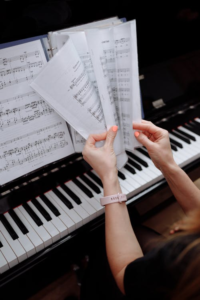
Many pianists taught to read music letter-by-letter progress slowly through scores, silently naming each note: E, G, B, D, F. They can decipher any piece eventually, but fluent sight-reading remains elusive.

Motivation seems like it should be simple. You either want to practice or you don’t. But decades of research in psychology reveals a more nuanced picture.
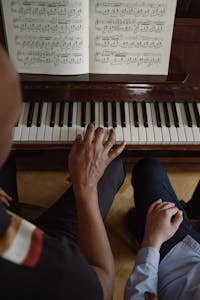
One of the most common requests from piano students is to skip ahead. “Can we learn this piece instead?” “I don’t need scales; can we just work on repertoire?” “Why do we have to learn this before moving on?” The impulse is understandable.
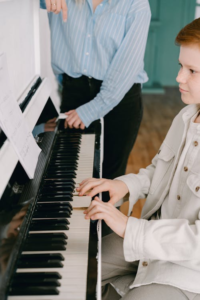
“Practice for 30 minutes” is not deliberate practice. Deliberate practice is a rigorous methodology based on decades of cognitive psychology research, formalized most notably by psychologist Anders Ericsson.

Your hands are shaking. Your heart is hammering against your ribs. In that moment, it is easy to believe that your body is betraying you. But that surge of adrenaline is not your enemy.

Every piano parent has been there. Your child sits down at the bench, plays through their piece once (maybe), then announces they are done. You know the recital is in three weeks. You know what their teacher assigned.

Traditional practice wisdom often recommends intensive focus: drill one scale for ten minutes, then move to arpeggios, then work on that difficult passage.
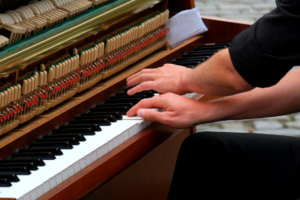
Most pianists understand that practice should be spread across multiple sessions rather than crammed into one marathon day. But the science goes deeper than general wisdom.

We often hear that consistency matters in piano practice, but timing matters too. Recent neuroscience research reveals that when you practice matters almost as much as how long you practice.

One of the most common questions I get from parents in the Clearwater area is: Is my child old enough to start piano? It’s a great question, and after years of teaching students of all ages, I have some honest thoughts on the matter.